The glass mountain
Notes on Ben Lerner's "Transcription"

Transcription, by Ben Lerner, is one of those rare novels that make us think through images. Even rarer is its ability to capture the current time and depict our way of life in this weird period of History. It’s like a painter painting a storm in its eye and still having the necessary sang-froid to put in a collective self-portrait. Incredibly, it works. Well, more than works — it breaks through the all-encompassing noise and it lingers with us as big questions do.
If we want to be rigorous, a great novel like this one is not about anything. It is what it is, like a house, a road, a light bulb in the night. And yet there are some themes, ideas, some motifs, let’s call them, that run through it and may help us excavate this one-hundred-and-something pages monument. I thought of transcribing some lines from the novel and go with them.
“In my desperation to reach my daughter I was sprinting away from her.” The unnamed protagonist is on a train, “facing opposite the direction of travel”, what his young daughter once called “facing the past”. He’s going to interview Thomas, his ninety-years old mentor, and, as he is listening to a talk Thomas gave on translation in 1973, he falls asleep dreaming. In the dream there’s some kind of Covid-related urgency and he must pick her kid from school. But there’s an infinite line of people, parents, outside the school gate, waiting to get in, so, in order to get her daughter back, he must sprint “away from her”. A permanent instability of space and time is one of this novel’s motifs. If that’s the right word; perhaps materials would be a better choice here. (I guess that’s part of Lerner’s brilliance: that the what of his writing is always somehow confused with its how.) But — time. In Transcription, as in our mad world, there’s no easy way back to the past anymore (for starters, everyone’s memory seems to be failing) and, as Max, Thomas’s son, puts it when speaking about his daughter’s “food intake disorder” and his own guilt as a father, there’s also “a sense of futurelessness, catastrophe — fires, floods, fascism”. This being so, it’s only natural that the present feels very much like a breach, a crack between two impossibilities.
The smartphone is, in a way, the symbol of this cracked present. It’s, of course, the main motif of this novel. (And, at the same time, no more than its MacGuffin?)
“Again my hand reached for the corpse of my phone.” The protagonist’s phone falls into the hotel bathroom sink and stops working just before the interview. During the talk, Thomas insists on being recorded and the embarrassed interviewer pretends to record it on his damaged phone. What is to become this great artist-thinker’s last conversation ends being not exactly a transcription, but something else conjured by the protagonist’s memory and imagination.
(Some years ago, after The Topeka School, Lerner’s third novel, and before his coming to Disquiet in Lisbon, I interviewed him in Brooklyn for Expresso, a Portuguese newspaper. We had a great talk, wandering in the Ford Hamilton Cemetery, but I didn’t record it, just took some notes. Some days after, we continued it online, and on record, and for me it felt a bit like, sitting in front of our screens, “facing the past”, we were restaging the memory of that walk. But, no, this is getting dangerously close to self-fiction, let me close this parenthesis right now.)
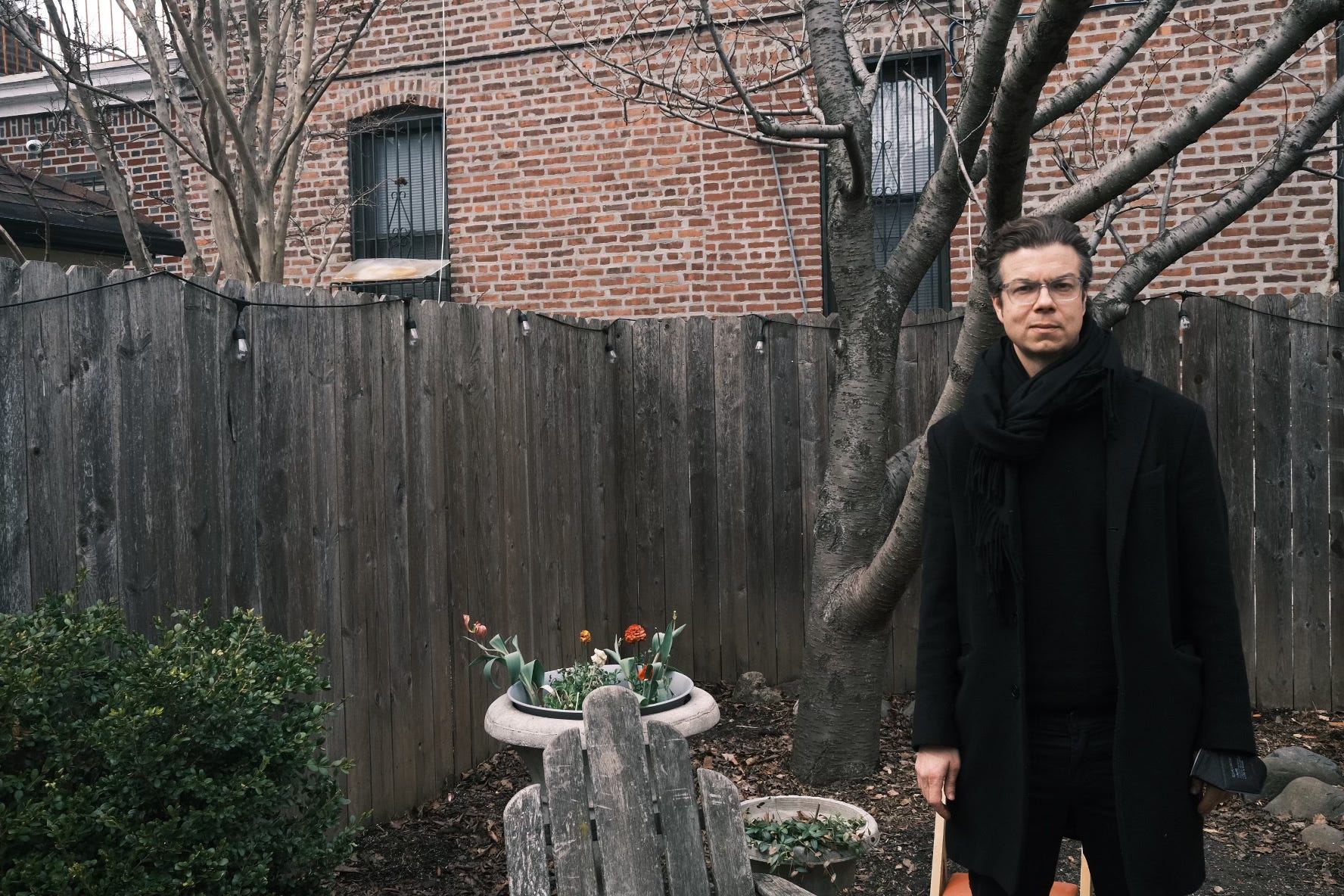
“I was having an unusual experience of presence.” In our smartphone-a-thousand-screens-always-connected lives, being alive in the world risks feeling like that, precisely, “an unusual experience of presence”. And this raises questions about what literature should do with it. I don’t have a theory, I’m afraid. I’m just saying that an interesting aspect of Transcription is the way it subtly creates a territory of absence (with its recordings, FaceTime calls, text messages, disputed or constructed memories, etc.), where the magic of technology falls short. Or, as Thomas says in the book, from a slightly different angle: “The dream is opposed to your phone, where no dead or distances are able to appear”. By the way, is this book a novel, a fictional essay, several superimposed theater plays, what? That question is also part of it, I guess. One the materials this text is made of.
Our lives become a crossover between the online and the offline worlds and it seems like nothing much has changed. It’s just technological progress, we tell ourselves, a different tool, whatever. The truth is that a lot of fundamentals do change, are changing; like our relationship with time and space, our capacity to be there for the other, to accept the otherness of something or someone, or our ability to forge new political horizons, for example. Our world, as Max says of his father after he had a near-death experience, is “just a little different, but more different for only being a little different”. And Transcription shows this with the mysterious clarity of a black mirror.
On page 20 (I have the Granta edition), the protagonist visits the glass flowers in the National History Museum, Harvard. Two artists, Leopold and Rudolf Blaschka, have made them a century ago in Dresden: “thousands of anatomically perfect flowers in perpetual bloom”. And, on page 21, he tells us: “I was typically unmoved by ‘unspoiled’ mountain views; after the glass flowers, I would see cracks in the rock face as penciled, as a history of small decisions, and then experience the view as beautiful.” Then he calls this a “quiet but crucial technique, somewhere between a child’s game, a CBT exercise, and a religion. Eventually”, he says, “I’d call this ‘fiction’.”
In a badly-scripted world where “reality” feels in between commas most of the time, this is what Ben Lerner’s Transcription does with words: it gives us back reality, penciled in a way that we cannot but recognize it — and, who knows, maybe recognize it as something we have to own up to.